
FC 26 – Best Camera Settings for Online & Offline Play – Duplicate – [#2875]
After testing every player switching method extensively, ball relative consistently proves to be the most reliable and beginner-friendly option, giving you faster reactions, better defensive control, and far fewer costly mistakes.

Table of Contents
Most players overlook switching settings, but they’re far more important than you think. The wrong switching method can actively make you worse, causing missed player selections, slower reactions, and defensive mistakes at the worst possible moments. When your switching isn’t consistent, you spend more time fighting the controls than actually defending.
That’s exactly why ball relative is such a game-changer. Because your switching is based on the ball — not your current player — it keeps your movements predictable, your eyes focused on the danger area, and lets you select the right defender faster. This means quicker decisions, cleaner transitions, and far fewer panic errors.
If you want a full breakdown with practical examples and step-by-step demonstrations, check out my FC School, where I cover these mechanics in depth and show you exactly how to implement them in real matches.
Check out the full video explained in detail showing you what each setting does with visual examples
Best EA FC 26 Player Switching Settings (Ball Relative Guide)
The switching settings below are the ones I’ve personally tested and refined over time to give you the most control and consistency while defending. Think about it — the more predictable your player switching is, the faster you can react. When you always know which defender you’re about to select, you make quicker tackles, cover runs earlier, and stop attacks before they even develop.
That’s exactly why ball relative is so effective. Instead of guessing or flicking around randomly, every switch is based on the ball’s position, keeping your decisions simple and your focus locked on the danger area. Less confusion, fewer mistakes, and much smoother defending overall.
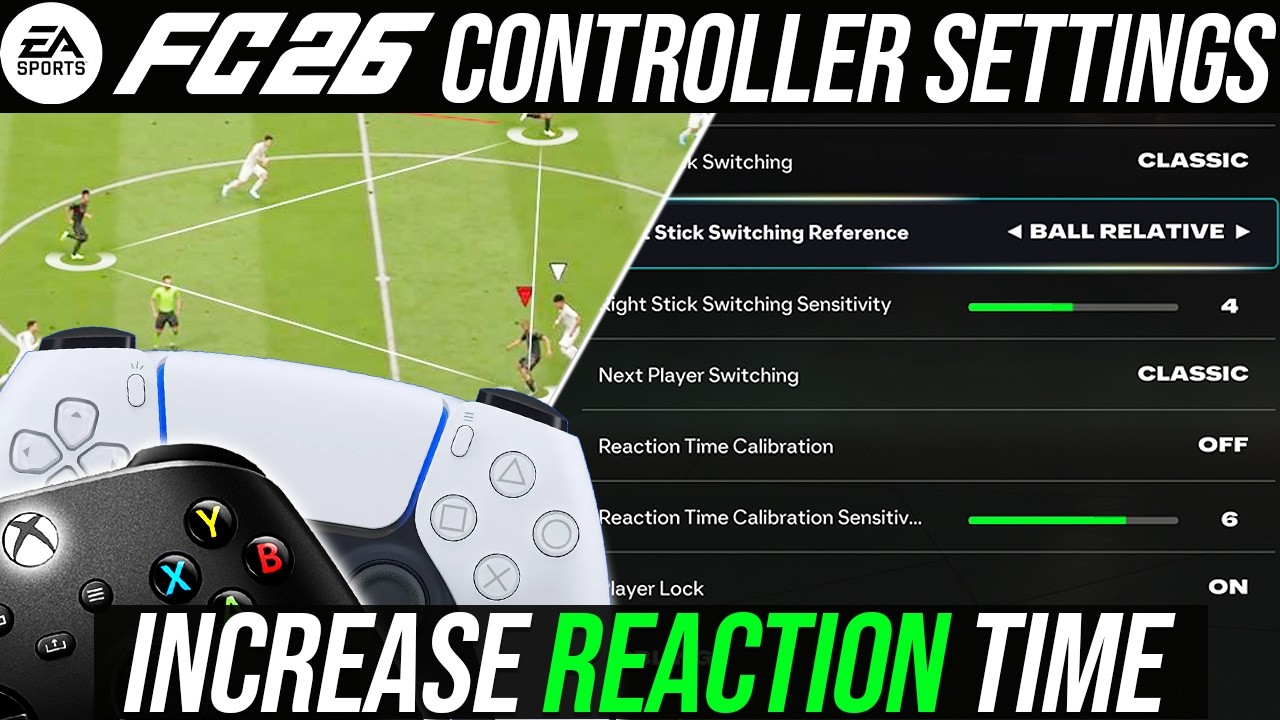
To change your switching method, head to Main Menu > Settings (gear icon) > Game Settings > Controller Settings > Right Stick Switching Reference, and set it to Ball Relative.

Why Should You Use Ball Relative Switching?
Ball relative switching is incredibly important because it lets you stay focused on what actually matters most — the ball.
When you’re defending, your eyes naturally track the ball and the danger around it. Ball relative works with that instinct, not against it. Instead of calculating angles based on your current player, every switch is made in relation to the ball’s position, which makes your inputs feel automatic and far more accurate.
This means you spot threats earlier, select the closest defender faster, and react before your opponent gets past you. There’s no panic flicking or guessing — just simple, consistent movements that always make sense.
I recommend every player switch to ball relative, especially if you struggle with missed switches or slow reactions. Once you get used to it, defending feels smoother, more controlled, and much more reliable overall.
Why Trust NealGuides:
NealGuides is a gameplay expert with one of the biggest tutorial channels for EA FC 26. He has repeatedly predicted powerful META mechanics in advance and turned them into practical guides that help players improve. He is also one of the very few members part of the EA Design Council, in which he travels to EA headquarters multiple times per year to play the game and provide feedback and as a consultant.
Through his 20 years of extensive football simulation knowledge, he now focuses on helping the average player get better at the game. He has coached over 10,000s of people exclusively through his FC School, and his YouTube channel boasts over 300,000 subscribers, with over 100 million views across all platforms. Best known for his tactics, he breaks down each tactic and formation exploring the different variations and adjustments for the viewers style, all his formations that he releases are testing by him and members of different skill levels before being released.
Why Do Some Pro Players Still Use Player Relative?
If ball relative is more consistent, you might wonder why some pro players still stick with player relative.
The answer is simple: habit.
Many top players have been using player relative for years — sometimes 5 to 10+ years. At that level, muscle memory is deeply ingrained. Switching methods would temporarily make them worse, even if the new system is technically more efficient. So they stay with what they’re already comfortable with.
It’s not necessarily because it’s better — it’s because it’s familiar.
Player relative can offer slightly more manual freedom, especially for very specific, early predictions like switching to a defender on the far side before a long ball. But these situations are rare and mostly relevant at the highest competitive level.
For the vast majority of players, consistency beats complexity. And that’s exactly where ball relative shines — fewer mistakes, faster reactions, and much simpler decision-making.
So don’t copy pros blindly. Use the method that gives you the most control, not the one you’re just used to.
Key Takeaways
Once you’ve switched to ball relative, the next step is making sure your tactics and formations actually support your defending.
Player switching and positioning go hand in hand. The better your structure on the pitch, the easier it is for ball relative to select the correct defender automatically. When your team shape is compact and organized, your CDMs, fullbacks, and center-backs are always in logical positions — which makes every switch faster and more predictable.
In other words, good tactics make ball relative even stronger.
So after updating your settings, take time to optimize your formations and defensive setup as well. The right structure combined with consistent switching will make your defense feel smoother, quicker, and far more controlled.
Switch to Ball Relative player switching — it’s the most consistent and reliable option in FC 26.
Switching settings matter more than you think. Poor switching leads to hesitation, wrong selections, and easy goals conceded.
Ball relative keeps every switch tied to the ball, so your inputs feel logical, reactions are faster, and you select the nearest defender almost every time.
Expect a short adjustment period. If it feels unfamiliar at first, that’s just muscle memory — a few practice matches and it becomes automatic.
Pair it with strong tactics and formations. Good defensive structure makes ball relative even more effective and predictable.
Check out my tactics and formation guides to optimize your setup.
Read my top 5 defending tips as well — they work hand-in-hand with ball relative and help you spot and stop attacks earlier.

Neal Guides
I am NealGuides, I run a Youtube Channel with over 300k+ Subscribers helping people get better at FC 26. We have helped millions of people improve.
I am part of the EA Design Council, in which I have played EA FC 26 early and provide feedback on the game to help shape its future.
I have coached many players in FC from the average casual, to pros, to real life footballers. If you want to improve at FC join my FC school series.
Want to improve at FC 26? Join my FC School Series


EA FC 26 has changed some of the default game settings that you may be used to. If you’re struggling with defending and shooting, it may be because EA has changed the “default controls”. Although at first it can seem challenging to understand what each setting does, largely down to not being particularly clear in-game.
I have a video below where I go through each setting in detail and explain what each setting does with visual examples. And remember if you are looking for detailed coaching or advice about this year’s game, make sure to check out my FC School (URL), where I offer in-depth guides about FC 26. (EA Website)
